What should professionals understand before choosing or switching to white-collar careers?
White-collar careers offer stability, strong earning potential, and clear growth pathways across industries like finance, tech, and healthcare. Understanding the roles, required skills, and salary ranges helps professionals choose paths aligned with long-term goals.
White-collar jobs are more than just desk-based roles - they’re the backbone of modern industries, spanning tech, finance, healthcare, education, and media.
And despite growing concerns about automation and AI, forecasts on Metaculus show only about a 7% chance that white-collar employment in the U.S. will see a significant decline before 2026.
In other words, these roles remain stable and highly competitive.
But what makes white-collar jobs so appealing?
From strong salaries to clear growth trajectories, these positions attract professionals aiming to build long-term careers in fields that reward expertise, problem-solving, and specialized skills.
Whether you're entering the workforce or considering a career switch, this guide breaks down everything you need to know about white-collar jobs.
What Are White Collar Jobs?
White-collar jobs refer to professional roles typically performed in office environments.
These jobs often involve managerial, administrative, or clerical work. Examples include financial managers, engineers, accountants, and executive assistants.
These roles are broadly categorized into:
- Managerial and Professional Occupations
- Technical, Sales, and Administrative Support Occupations
While educational qualifications and specialized skills are prerequisites for most white-collar jobs, attributes like time management and leadership abilities can set you apart.
For example, fields such as law, healthcare, and business often prefer candidates with master’s degrees.
Related Read: What are some of the highest-paying blue-collar jobs?
What Are the Highest-Paying White Collar Jobs?
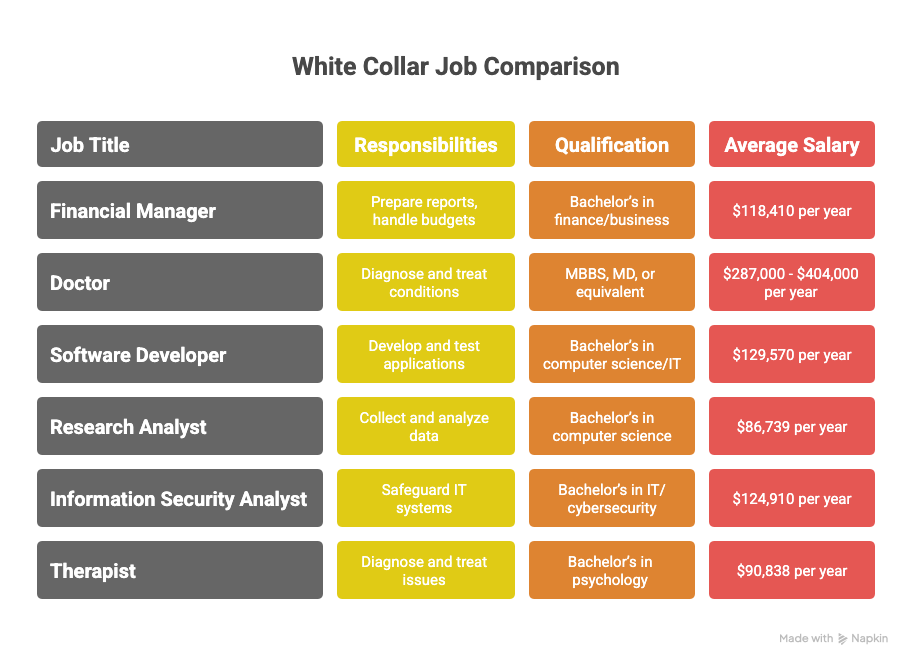
Here are some top white-collar jobs, their qualifications, and earning potential:
1. Financial Manager
- Responsibilities: Prepare financial reports, handle budgets, and suggest cost-cutting strategies.
- Qualification: Bachelor’s degree in finance, business, or accounting.
- Average Salary: $118,410 per year
Related Read: How to write a financial analyst resume in 2026?
2. Doctor
- Responsibilities: Diagnose and treat medical conditions.
- Qualification: MBBS, MD, or equivalent medical degree.
- Average Salary: Primary Care Physicians (PCPs) in the United States earned an average of $287,000, while Specialists earned an average of $404,000.
Related Read: How to make a resume for physician assistant jobs?
3. Software Developer
- Responsibilities: Develop and test software applications.
- Qualification: Bachelor’s degree in computer science or IT.
- Average Salary: $129,570/year
Related Read: What is the salary of a software developer in 2026?
4. Research Analyst
- Responsibilities: Collect and analyze data to guide business decisions.
- Qualification: Bachelor’s degree in computer science or related field.
- Average Salary: $86,739/year
5. Information Security Analyst
- Responsibilities: Safeguard organizational IT systems.
- Qualification: Bachelor’s degree in IT, cybersecurity, or related field.
- Average Salary: $124,910/year
Related Read: Top cybersecurity jobs in 2026
6. Therapist
- Responsibilities: Diagnose mental health issues and provide treatment.
- Qualification: Bachelor’s degree in psychology. Certifications enhance employability.
- Average Salary: $90,838/year

What Are the Best White Collar Jobs for Freshers?
Fresh graduates often wonder where to start in the white-collar job market. Here are some ideal entry-level options:
1. Customer Care Executive
- Responsibilities: Assist customers, resolve queries, and maintain client relationships.
- Qualification: Bachelor’s degree and strong communication skills.
- Average Salary: $60,414/year
2. Marketing Executive
- Responsibilities: Develop marketing campaigns and strategies.
- Qualification: Bachelor’s degree in business, marketing, or a related field.
- Average Salary: $53,083/year
Related Read: How to create an impressive CV for marketing graduates
3. Data Entry Operator
- Responsibilities: Enter and manage data records.
- Qualification: High school diploma.
- Average Salary: $30,000/year
4. Sales Executive
- Responsibilities: Support sales teams and achieve revenue targets.
- Qualification: Bachelor’s degree in business administration.
- Average Salary: $82,507/year
What is the Difference Between Blue Collar & White Collar Jobs?
| Aspect | White-Collar Jobs | Blue-Collar Jobs |
|---|---|---|
| Work Environment | Office-based, often involving managerial or administrative tasks. | Physical labor, typically in industrial or outdoor settings. |
| Education | Requires at least a high school diploma or college degree. | Focus on skills; formal education is often optional. |
| Pay Structure | Salaried positions with added benefits. | Hourly wages with fewer benefits. |
| Skillset | Cognitive skills like problem-solving and leadership. | Practical and technical skills, such as manual dexterity. |
| Examples | Lawyer, engineer, financial analyst. | Electrician, mechanic, construction worker. |
Related Read: Highest-paying blue-collar jobs in 2026
What are the Must-Have Skills & Qualifications for White Collar Jobs
Regardless of your industry, these skills are essential for excelling in white-collar roles:
1. Education and Knowledge
- College degree or advanced education in your field.
- Industry-specific knowledge and certifications.
Related Read: How to list education on a resume?
2. Communication Skills
- Strong verbal and written communication.
- Active listening and persuasion skills.
3. Problem-Solving Abilities
- Critical thinking and data analysis.
- Innovative solutions for business challenges.
Related Read: Leveraging analytical skills for business success
4. Adaptability and Flexibility
- Change management and learning agility.
- Ability to juggle multiple priorities effectively.
5. Technology Proficiency
- Comfort with productivity and collaboration tools.
- Digital literacy and tech-savviness.
Related Read: Mastering IT skills in 2026
White-Collar Jobs — FAQ
Which job is considered white-collar?
Professional, administrative, or managerial roles performed in office settings—such as accountants, analysts, engineers, and executives.
What is a blue-collar job?
Roles involving manual or skilled physical work, often in construction, manufacturing, maintenance, or transportation.
What are gold-collar jobs?
Highly specialized, high-earning positions in fields like tech, law, medicine, engineering, and AI research.
What is a red-collar job?
Government or public-sector roles, named after the red ink commonly used in government accounting.
What are pink-collar jobs?
Service-oriented roles historically dominated by women, such as nursing, teaching, childcare, and customer support.
What are grey-collar jobs?
Jobs blending white-collar and blue-collar skills—like technicians, paramedics, and field service engineers.
What are common white-collar jobs?
Roles such as financial analysts, software developers, HR managers, researchers, consultants, and marketing executives.
What is the salary range for white-collar jobs?
Salaries typically range from $45,000 to over $200,000 annually, depending on industry, role, and specialization.
What is the difference between white-collar and blue-collar jobs?
White-collar work is office-based and professional; blue-collar work involves manual labor or skilled trades, often in industrial environments.