Is Toastmasters worth it in 2026 for career growth and communication confidence?
Toastmasters is worth it for most professionals if they treat it as a long-term practice lab for communication, leadership presence, and feedback skills. It offers low-cost, high-frequency speaking reps and peer evaluation, making it a strong ROI option for building confidence under pressure, especially when paired with tools that help apply those skills to interviews and career outcomes.
Most professionals leave money on the table because they are too terrified to speak up in high-stakes meetings.
It is a career bottleneck that no degree can fix.
And when over 60% of employers rate oral communication on par with a candidate’s technical skill, how you speak often carries as much weight as what you know.
If this is a gap for you, Toastmasters International offers one of the most cost-effective ways to close it - turning public speaking from a source of stress into a practical career skill.
Here’s what you need to know about Toastmasters, and whether it’s worth your time.
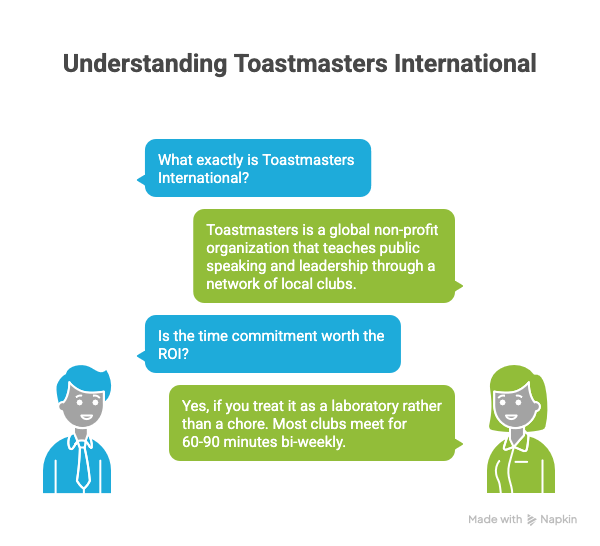
What exactly is Toastmasters International?
Toastmasters is a global non-profit organization that teaches public speaking and leadership through a network of local clubs. Members move through "Pathways," a self-paced curriculum, while practicing prepared speeches and impromptu "Table Topics" in a supportive environment. It transforms the high-stakes pressure of a boardroom into a low-stakes laboratory for personal growth.
According to the official Toastmasters International website, the organization spans 140+ countries with over 14,000 clubs. Unlike a seminar, it’s a "learn-by-doing" model.
You aren't just listening to a lecture; you are the performer, the evaluator, and the timer.
This experiential learning is why, according to a LinkedIn Workplace Learning Report, "communication" remains the #1 most in-demand skill globally.
Is the time commitment worth the ROI?
Yes, if you treat it as a laboratory rather than a chore. Most clubs meet for 60-90 minutes bi-weekly. For an annual cost of roughly $120 - less than one session with a private coach, you get 24+ hours of stage time and peer feedback, which significantly accelerates professional maturity and leadership presence.
While the financial cost is low, the "opportunity cost" is what stops people.
The Real Math of Toastmasters
| Feature | Toastmasters | Executive Coaching |
|---|---|---|
| Annual Cost | ~$120 - $150 | $2,000 - $10,000+ |
| Frequency | Weekly/Bi-weekly | Monthly/Quarterly |
| Network | Diverse (All industries) | Solitary |
| Curriculum | 11 Specialized Paths | Bespoke/Variable |
Can Toastmasters actually cure public speaking anxiety?
It doesn't "cure" anxiety; it builds a higher tolerance for it through "exposure therapy." By repeatedly speaking in a safe environment, your brain reclassifies public speaking from a "threat" to a "task." According to psychological studies on social anxiety, consistent exposure is the most effective way to reduce the physiological symptoms of glossophobia.
Toastmasters uses a structured feedback loop - the "Sandwich Method" (praise, improvement, praise) to rewire your brain's response to criticism.
"The only way to learn to speak is to speak and speak, and speak and speak, and speak and speak and speak." - Dale Carnegie (often cited in Toastmasters curriculum).
Also Read: 7 Remote Work Best Practices to Boost Your Professional Image
How does it compare to expensive professional coaching?
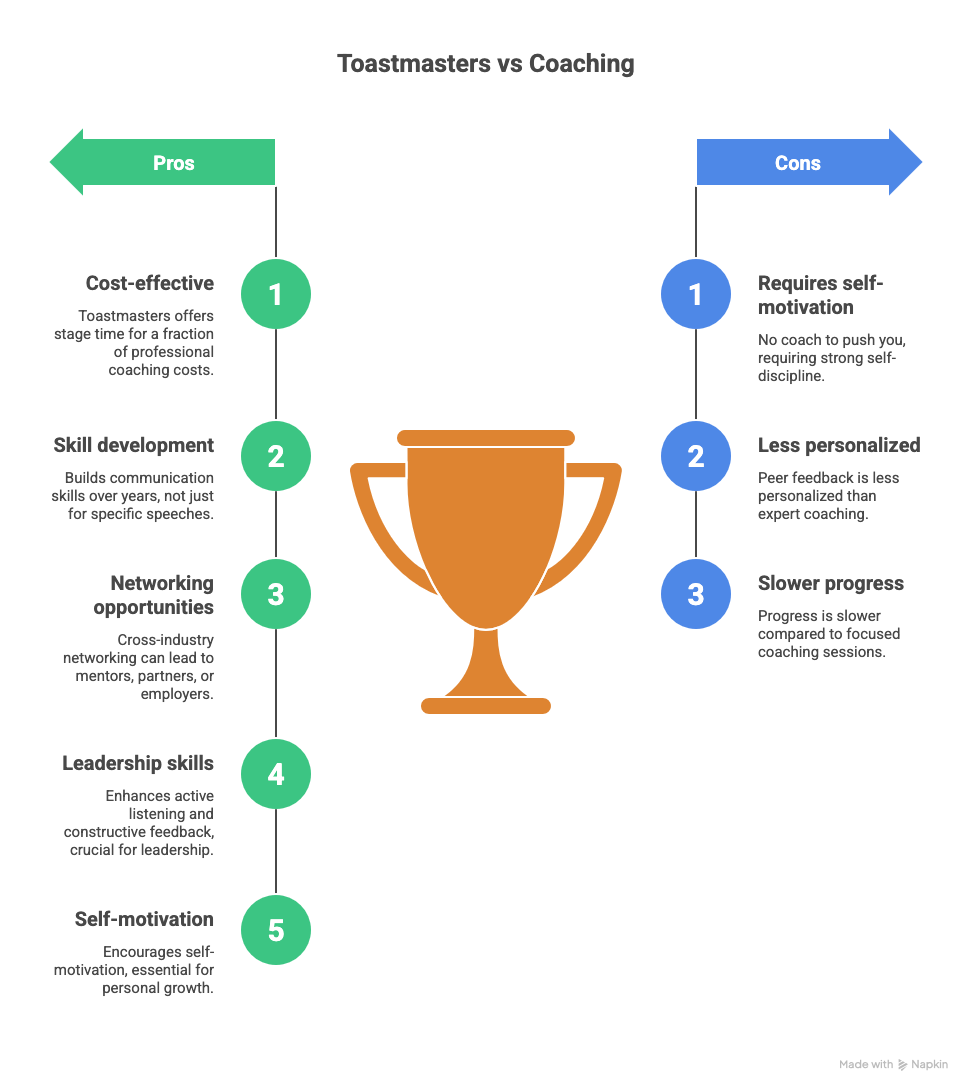
Toastmasters provides a peer-to-peer feedback loop, whereas coaching offers expert-to-peer guidance. While a coach can fix a specific speech for a keynote, Toastmasters builds the underlying "muscle" of communication over years. It is the gym; a coach is the personal trainer you hire for a specific transformation.
According to data from the International Coaching Federation (ICF), the average hourly rate for a business coach is $244.
If you are on a budget, Toastmasters provides the same "stage time" for a fraction of the price. The catch?
You have to be self-motivated. There is no coach breathing down your neck to finish your "Pathways" projects.
What are the hidden benefits nobody tells you about?
Beyond speaking, Toastmasters hones "active listening" and "instant evaluation" skills. You learn to give constructive feedback that doesn't alienate coworkers, a critical leadership trait. Additionally, the networking is cross-industry, meaning you might find your next mentor, business partner, or employer sitting right next to you at a local community center.
According to a Harvard Business Review analysis on leadership, the ability to provide effective feedback is the most significant predictor of managerial success.
In Toastmasters, you are forced to evaluate others every meeting. This sharpens your ability to:
- Identify "filler words" (um, ah, so) in your own speech.
- Structure thoughts under pressure (Table Topics).
- Run efficient meetings (the Toastmaster of the Day role).
Should you join or skip? The 3-Point Checklist
Don't join just because your boss told you to. Join if:
- You want to lead: Leadership is 90% communication.
- You are an "Introvert in Tech": If your brilliance is being ignored because you're quiet in meetings, Toastmasters gives you the "volume" you need.
- You need a safe place to fail: Better to mess up a speech in a club of 15 friends than in front of a 500-person conference.
Skip it if:
- You have an immediate deadline: If your big presentation is in 48 hours, hire a private coach. Toastmasters is a slow-burn process.
- You dislike rigid structure: The meetings follow a strict agenda. If you find "Robert’s Rules of Order" or "Timer Lights" annoying, you will struggle to enjoy the process.
- You want "Expert-Only" feedback: Remember, your evaluators are often fellow learners. While peer feedback is valuable for confidence, it can sometimes lack the technical depth provided by a professional speechwriter or a linguist.
Also Read: How to build an executive presence and inspire confidence as a leader?
To Sum Up
Toastmasters builds the habit of speaking clearly under pressure. What it doesn’t do is connect that skill directly to resumes, interviews, and real hiring signals.
That’s where Hiration fits naturally. Hiration helps professionals apply communication skills where they matter most - structuring answers, explaining impact, and showing clarity in resumes and interviews.
Not as a replacement for practice, but as a way to translate it into outcomes employers actually evaluate.
Strong communication opens doors. Knowing how to demonstrate it is what gets you through them.
Toastmasters ROI in 2026 — FAQs
What is Toastmasters International and how does it work?
Toastmasters is a global non-profit club network that teaches public speaking and leadership through practice-based meetings, where members deliver speeches, respond to impromptu prompts, and evaluate each other using a structured format.
Is Toastmasters worth the time commitment for working professionals?
For most professionals, yes. The time commitment is usually manageable, and the value comes from repeated speaking practice, feedback, and confidence-building that compounds over time in meetings, presentations, and leadership situations.
Can Toastmasters actually reduce public speaking anxiety?
Toastmasters does not instantly eliminate anxiety, but it helps reduce it through repeated exposure in a safe environment, which builds tolerance, familiarity, and a more stable response to speaking under pressure.
How is Toastmasters different from hiring a speaking coach?
Toastmasters is a low-cost, peer-driven practice system for building communication skills over time, while a coach provides expert guidance for specific goals like preparing for a major presentation or improving a particular speaking weakness.
What are the hidden benefits of Toastmasters beyond public speaking?
Toastmasters also strengthens active listening, constructive feedback, fast thinking, meeting facilitation, and cross-industry networking, all of which are valuable for leadership growth and workplace credibility.
Who should join Toastmasters in 2026?
Toastmasters is a strong fit for professionals who want to lead, speak up more confidently in meetings, or practice communication in a low-risk setting before higher-stakes workplace situations.
Who should skip Toastmasters or choose another option?
If you need urgent help for a presentation in the next few days, prefer unstructured learning, or want only expert-level critique, a private coach may be a better short-term option than Toastmasters.
How can professionals turn Toastmasters practice into real career outcomes?
The key is applying speaking practice to real hiring and workplace moments, such as interviews, resume impact statements, and executive communication, so stronger communication habits translate into clearer professional outcomes.