What should nurses focus on when preparing for interviews?
Strong interview prep blends clinical clarity with emotional intelligence. Use the Present-Past-Future framework for personal questions, STAR for behavioral questions, and ABC/Maslow for clinical scenarios. Prioritize patient-outcome examples, show how you stay calm under pressure, and demonstrate safe judgment in ambiguous situations. Hiring teams look for nurses who think clearly, communicate transparently, and advocate for patients confidently. Note: The employment statistics included come from your draft; I have not independently verified the numbers.
Nursing is moving through a period of rapid expansion.
The Bureau of Labor Statistics estimates a 5% growth in RN roles from 2024 to 2034, adding nearly 194,500 openings every year.
With demand rising this quickly, hospitals are looking for nurses who bring not just strong medical judgment, but resilience, emotional intelligence, communication skills, and the ability to stay composed under pressure.
And where do these qualities show up most clearly? In the interview - which is why preparation matters.
Read on to explore nurse interview questions you’re most likely to encounter.
How do I answer common nurse interview questions?
Focus on the "Present-Past-Future" framework for personal questions and the STAR method for behavioral ones. Keep your answers concise (under two minutes) and always tie your personal motivations back to patient care outcomes.
For example, when asked about your strengths, don't just list adjectives; describe a specific clinical moment where that strength saved the day.
Hiring managers often start with these foundational questions to gauge your personality and professional fit. Here are some commonly asked questions:
- Tell me about yourself. (Start with your current role, briefly mention your background, and end with why you want this specific job).
- Why did you choose nursing? (Share a personal story that highlights your commitment to care).
- Why do you want to work here? (Research their specific awards or community programs).
- What is your greatest strength? (e.g., "My ability to remain calm in a crisis.").
- What is your greatest weakness? (Choose a real weakness like "delegation" and explain how you are improving it).
- Where do you see yourself in 5 years? (Mentioning goals like becoming a nurse practitioner shows ambition, but emphasize your commitment to the current unit first).
- Why are you leaving your current job? (Focus on growth, not negative experiences).
- How do you handle stress? (Mention specific coping mechanisms like exercise or meditation).
- What are your salary expectations? (Research is key - know the market rate).
- Describe yourself in three words. (Compassionate, Resilient, Detail-oriented).
Also Read: How to write a job winning RN resume?
How do I master behavioral interview questions?
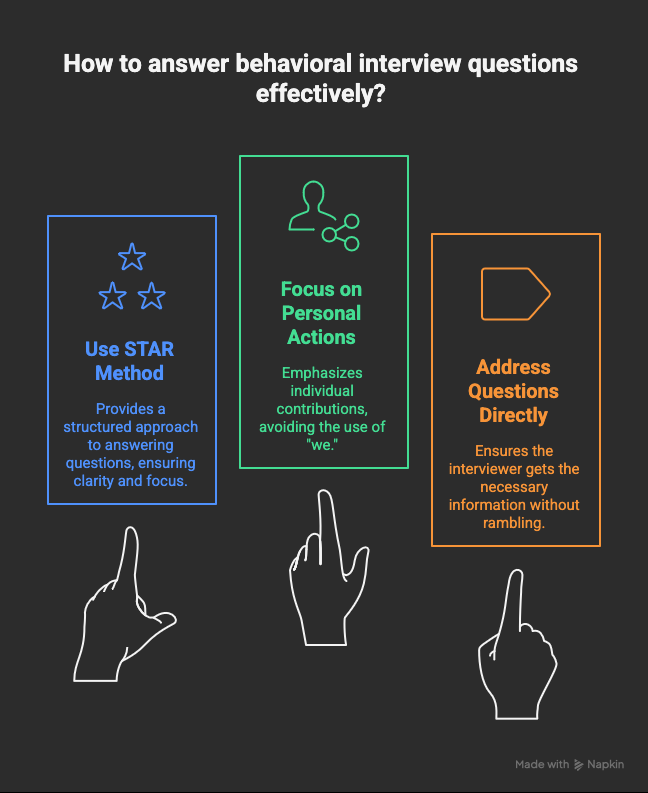
Use the STAR Method: Situation (brief context), Task (what you needed to do), Action (what you specifically did), and Result (the positive outcome). This prevents rambling and ensures you take credit for your contributions. Avoid using "we" too much; the interviewer wants to know what you did.
Given below are some top nurse behavioral interview questions:
- Tell me about a time you had a conflict with a coworker. (Focus on the resolution and maintaining patient safety).
- Describe a time you made a medical error. (Own the mistake immediately and explain the protocol you followed to fix it).
- Tell me about a time you dealt with a difficult patient. (Highlight your de-escalation skills).
- Describe a time you went above and beyond. (This is your chance to shine).
- Tell me about a time you advocated for a patient. (e.g., Questioning a doctor’s order).
- Describe a time you were under extreme pressure. (How did you prioritize?).
- Tell me about a time you had to adapt to a sudden change. (Show flexibility).
- Describe a time you stepped into a leadership role. (Even informally, like mentoring a student).
- Tell me about a time you disagreed with a supervisor. (Show respect and evidence-based reasoning).
- Describe a time you handled a family member who was unhappy with care.
What clinical scenario questions should I expect?
Clinical scenarios test your critical thinking and prioritization. Always "think out loud" so the interviewer can follow your logic. Prioritize using the ABC (Airway, Breathing, Circulation) or Maslow’s Hierarchy of Needs frameworks.
Even if you don't know the exact answer, explain how you would find it (e.g., "I would consult the charge nurse or hospital policy...").
Here are some high stakes scenario interview questions:
- You walk into a room and the patient is unresponsive. What are your immediate steps? (Assess → Call Code → CPR/Follow ACLS protocols).
- You notice a physician has ordered a medication dosage that seems incorrect. What do you do? (Check order, consult pharmacist/resource, query the doctor).
- How do you prioritize three patients: one with a sudden drop in O2 sat, one leaving for surgery in 10 minutes, and one with 8/10 pain? (The O2 sat patient is a top priority, based on ABCs).
- A conscious, competent patient refuses a critical, life-saving medication. How do you respond? (Educate on risks/benefits, document refusal, notify the provider).
- You observe a colleague breaking sterile field protocol during a procedure. What is your action? (Stop the procedure immediately to ensure patient safety).
- How do you ensure a non-English speaking patient fully understands their discharge instructions? (Use certified translation services, not family).
- What is your systematic process for conducting a rapid head-to-toe assessment?
- How do you handle a suspected case of child or elder abuse? (Follow mandatory reporting protocols and documentation).
- What is your strategy for managing your workload when you are short-staffed and overwhelmed? (Prioritize, delegate, and ask for help).
- How do you ensure HIPAA compliance when discussing care with visitors present in a semi-private room? (Ask for patient's explicit permission).
Also Read: How to get remote nursing jobs?
What questions should I ask the interviewer?
Never say "I have no questions." It suggests a lack of interest. Prepare 3-5 questions that show you are thinking about your long-term fit and the unit’s culture. Ask about support systems, ratios, and professional development.
Here are some good questions to ask the interviewers:
1. What is the nurse-to-patient ratio on this unit?
2. How does the unit handle conflict or high-stress situations?
3. What is the orientation process for new hires?
4. What opportunities exist for professional development or obtaining certifications?
5. How is success measured for this role in the first 90 days?
6. What are the biggest challenges currently facing this unit?
7. How does management support nurses dealing with burnout?
8. Is this a Magnet-designated facility?
9. What is the weekend/holiday rotation schedule?
10. What do you enjoy most about working here?
Also Read: What are some commonly asked LPN interview questions?

Conclusion
The nursing field is demanding, but for a well-prepared candidate, the opportunities are wide open.
By mastering these questions and sharpening both your clinical and interpersonal skills, you show interviewers that you’re ready to contribute from day one.
And if you want structured practice before the real thing, Hiration can help you refine your answers, improve your delivery, and walk in with more confidence - from tailored mock interviews to clean, ATS-friendly resumes that highlight your strengths clearly.
At the end of the day, an interview is simply a conversation about your skills and your character.
You already have the training; now show them the nurse you’re becoming.
Nurse Interview Preparation — FAQ
How long should my interview answers be?
Keep responses under two minutes. Use STAR for behavioral questions and think out loud for clinical scenarios so interviewers can follow your reasoning.
What’s the best way to answer “Tell me about yourself” as a nurse?
Use Present → Past → Future. Start with your current role, mention your strongest clinical experiences, and end with why this unit aligns with your goals in patient care.
How do I answer questions about conflict with coworkers?
Show professionalism: focus on patient safety, clear communication, and resolution. Avoid blaming language—demonstrate teamwork, escalation when needed, and a positive outcome.
How do I talk about a medical error without ruining my chances?
Own it immediately, describe the safety protocol you followed, explain what you learned, and highlight steps you've taken to prevent recurrence. Accountability matters more than perfection.
How should I prioritize during clinical scenario questions?
Use ABC (Airway, Breathing, Circulation). If applicable, include Maslow or SBAR for communication. Explain why you’re prioritizing — interviewers want to see your thinking, not just your answer.
What’s the right way to discuss weaknesses in a nursing interview?
Pick a real, non-critical weakness (such as delegating or documentation pace), explain how you’re actively improving it, and tie it to better patient outcomes.
How do I handle questions about difficult patients or families?
Show empathy, de-escalation skills, and professional boundaries. Emphasize communication, patient safety, and collaboration with the care team when needed.
What if I don’t know the exact clinical answer?
Explain your process: assess, review policy, consult charge nurse, or escalate. Safe judgment and knowing when to ask for help are essential nursing competencies.
How many questions should I ask the interviewer?
Prepare at least 3–5. Ask about patient ratios, orientation, support systems, burnout prevention, or growth opportunities. Never end with “No questions.”
What’s the biggest mistake nurses make in interviews?
Being too general. Avoid vague claims about being “hardworking” or “compassionate.” Use specific clinical examples that demonstrate judgment, empathy, and reliability.