You've turned detective, investigating your resume.
As the magnifying glass hovers over your achievements, "investigate" seems to sneak in a tad too often.
Indeed, it's an important action verb, especially for profiles that require analytical depth - hiring managers prefer specific verbs like "assessed," "analyzed," and "investigated".
Yet, diversifying its usage can enhance the storytelling quality of your resume, boosting interview chances by up to 140% with strong action verbs that clearly convey achievements.
Let’s journey into the lexicon of investigation and shed light on alternatives.
Engaging Alternatives for "Investigate"
When you swap out repetitive verbs, you're not just polishing language, you’re sharpening how clearly your achievements land.
Recruiters skim quickly, and verbs are often the first anchors their eyes catch.
Using varied, vivid action words helps them instantly understand how deep, how structured, and how proactive your contribution was.
A strong synonym should do one of following things:
- Clarify the Level of Depth
Different roles require different layers of inquiry.
- Examine → surface-level review.
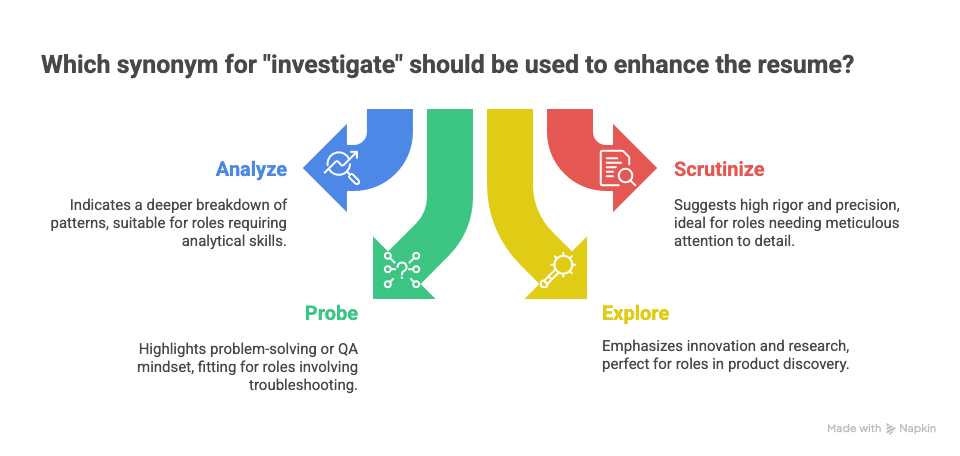
- Analyze → deeper breakdown of patterns.
- Scrutinize → high rigor and precision.
Choosing the right verb helps recruiters gauge your technical intensity without extra words.
2. Signal Your Functional Skillset
Alternatives for "investigate" can subtly highlight your domain strengths:
- Audit → financial acumen and compliance.
- Probe → problem-solving or QA mindset.
- Explore → innovation, research, or product discovery.
This makes your resume role-aligned without adding long explanations.
3. Show How You Drive Outcomes
Strong investigation verbs naturally pair with measurable achievements.
For example:
“Analyzed customer churn patterns and uncovered the top three drivers, informing a 12% retention lift.”
This structure helps your resume stay achievement-focused, not task-focused.
4. Improve ATS Relevance Without Keyword Stuffing
Many ATS systems treat synonyms as separate verbs.
By using a mix - analyze, audit, examine - you cover more skill-related variations that hiring teams may search for, boosting discoverability without sounding forced.
5. Match Tone to Industry Expectations
Different industries value different styles of inquiry:
- Finance → audit, review, assess
- Engineering/QA → probe, inspect, diagnose
- Product & Research → explore, investigate, delve into
- Consulting → analyze, evaluate, dissect
This tailoring helps your resume feel naturally aligned with the roles you're targeting.
6. Highlight Your Cognitive Approach
The investigation verb you choose can hint at whether you:
- break things down logically (analyze)
- think creatively and seek new opportunities (explore)
- verify rigorously (scrutinize)
- find root causes (probe)
Hiring managers love candidates who show how they think—not just what they did.
Also read: 250+ Resume Action Words & Power Verbs
From Curiosity to Clarity
Choosing the right synonym for investigate isn’t just about swapping words, it’s about dialing in the precision of your intent.
Recruiters read verbs as signals: they reveal whether you’re gathering information, validating assumptions, solving problems, or uncovering insights.
The closer your verb matches the actual cognitive step you took, the clearer your impact becomes.
A strong investigation verb can help you:
- Map Your Thinking Process
Hiring managers want to understand how you work:
- Did you begin with broad exploration?
- Did you narrow focus as patterns surfaced?
- Did you validate final insights with rigor?
Selecting exact verbs subtly shows your analytical journey.
2. Differentiate Between Stages of Inquiry
Every complex task moves through phases:
- Discovery (explore, inquire, study)
- Diagnosis (probe, analyze, scrutinize)
- Validation (inspect, audit, verify)
Aligning your verbs with these stages makes your achievements sound structured and methodical.
3. Strengthen the Credibility of Achievements
When verbs accurately reflect your level of involvement, your bullet points resonate more:
“Probed recurring system failures to pinpoint root causes” feels more authoritative than “looked into system issues.”
Precision builds trust.
4. Improve Readability With Natural Variation
Resumes with repeated verbs flatten your narrative, making every action sound identical.
Using thoughtfully varied synonyms adds rhythm, helping each bullet point stand out, especially when recruiters skim.
5. Showcase Problem-Solving Style
Whether you’re a pattern-finder, a detail-checker, a trend-spotter, or a root-cause hunter, your verb choice instantly signals your signature working style - without explicitly stating it.
6. Align With Job Description Language
Most job postings include verbs tied to investigation - analyze, assess, research, evaluate. Matching your synonyms to the employer’s vocabulary improves ATS relevance and helps human reviewers see the fit more quickly.
Also read: What are some good synonyms for the word "learn"?
The Investigative Personality
Your choice of synonym doesn't just reflect the task but also hints at your working style.
Are you an "inspector," someone hands-on, wanting to see things for yourself?
Or are you a "researcher," comfortable delving deep into data and reports?
Maybe you’re the "prober," dissecting issues layer by layer.
Your verbs can be windows into your work psyche, offering employers a glimpse into how you approach problems.
Investigate Synonym FAQs
- What is the other word for investigate?
Common alternatives include examine, probe, inspect, study, and look into.
2. What is the synonym of investigation?
A few clear options are inquiry, examination, probe, inspection, and analysis.
3. What is a synonym for investigate thoroughly?
You can use scrutinize, delve into, go over with a fine-tooth comb, or conduct an in-depth inquiry.
4. What is the synonym of investigative?
Useful substitutes include inquisitive, analytical, examining, fact-finding, and probing.
Also read: What are some dynamic synonyms for the word "build"?
Conclusion
As you piece together your resume, remember, it's more than a ledger of what you've done.
It's a narrative. The words you choose play a pivotal role in articulating not just your actions, but your thought processes, your methodology, and your professional persona.
If you ever want help refining your wording, choosing stronger action verbs, or polishing your overall resume, Hiration’s AI-powered tools can assist with real-time rewrites, JD-based optimization, and ATS-friendly suggestions that make your story more compelling.
Craft intentionally. Edit thoughtfully. Let your resume reflect who you truly are as a professional.